
In fifteen years of shamanic work, in ceremony and one-to-one, in Ireland and overseas, I have never once seen someone become free without first turning around and facing the part of themselves they had been running from. That part has a name. Carl Jung called it the shadow.
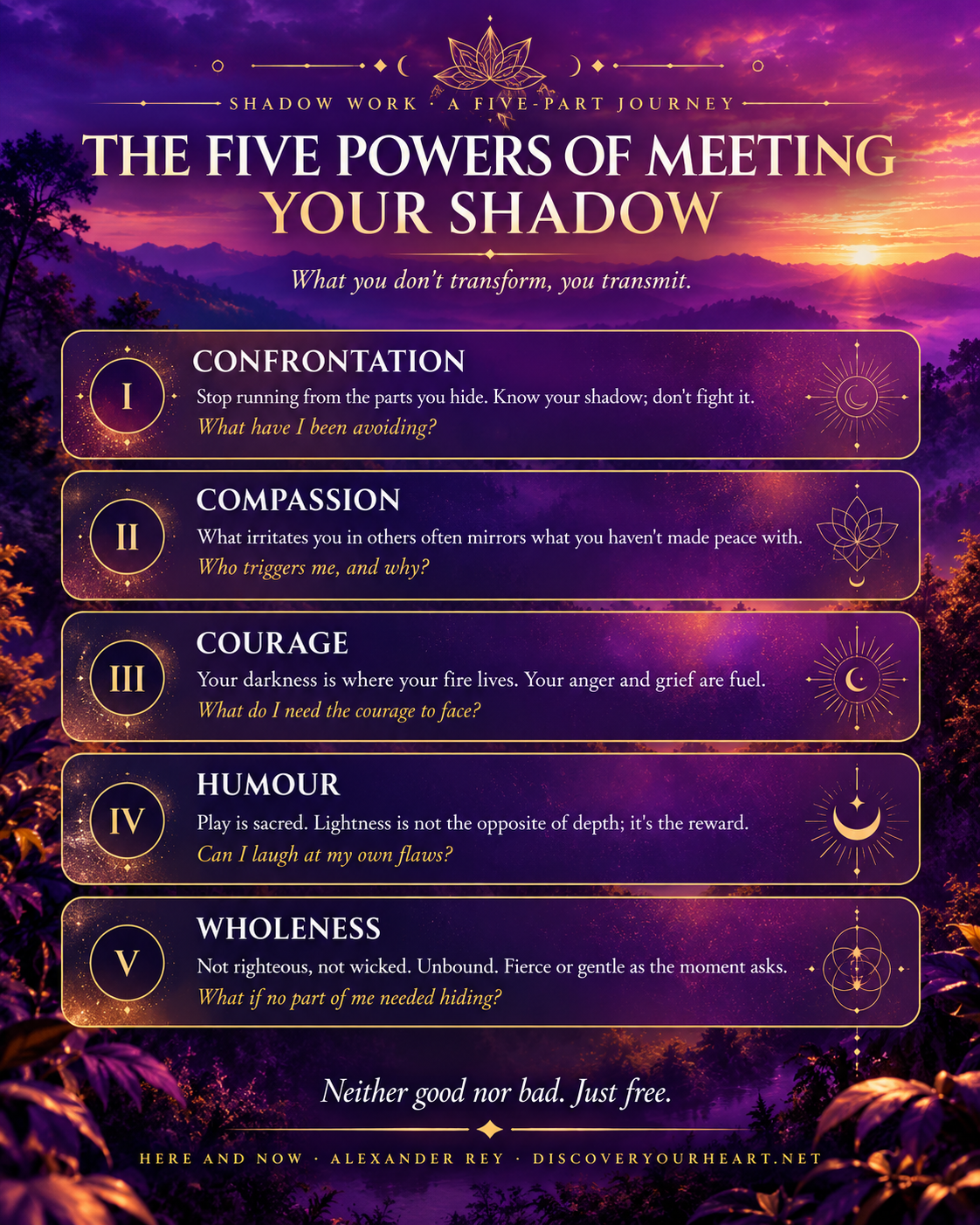
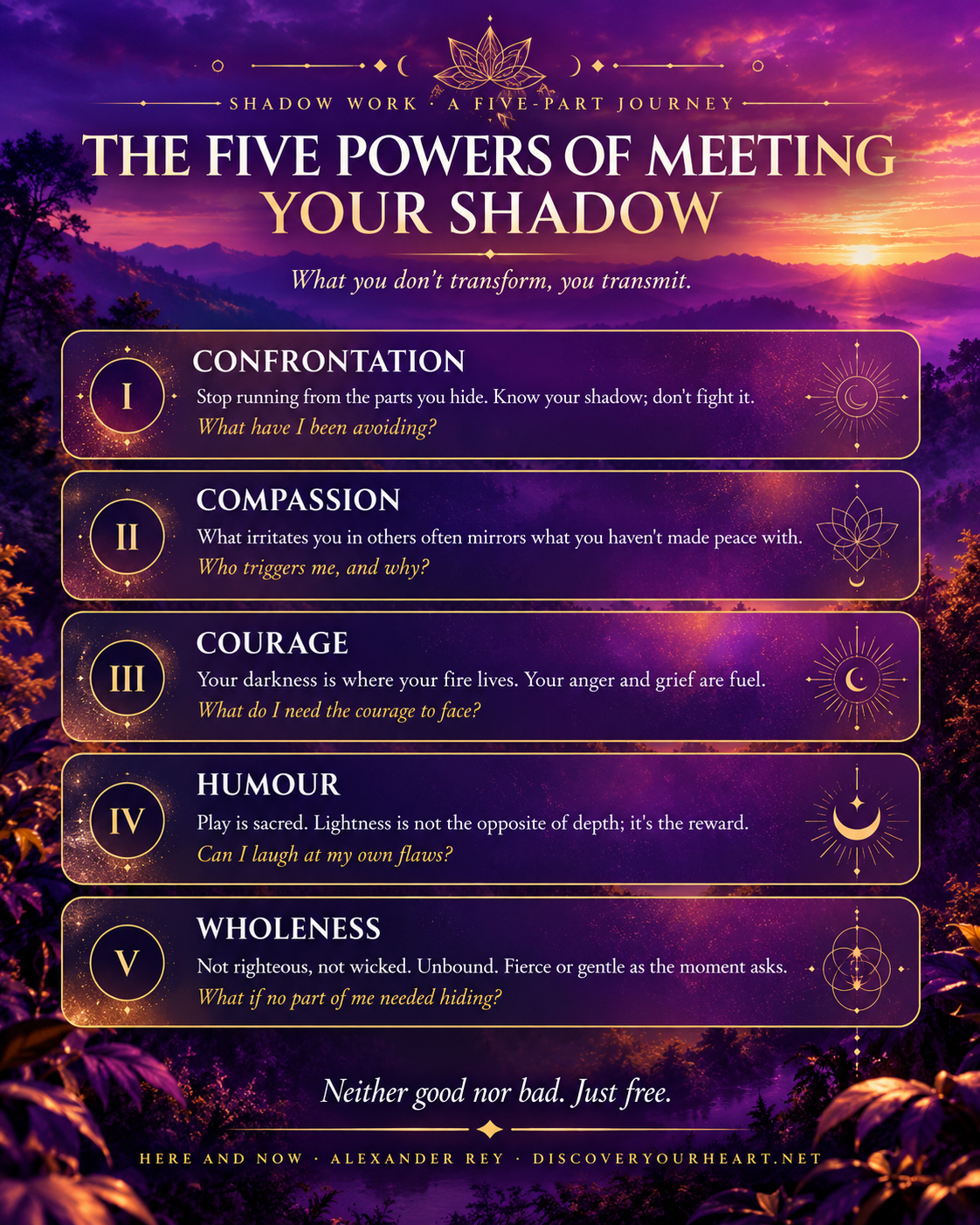
Shadow work is not about spiralling into trauma or scaring yourself. It is a path with five gifts, and each one opens the door to the next:
- Confrontation — meeting the shadow you keep running from
- Compassion — seeing the shadow in others without judgment
- Courage — finding the fire that lives in your darkness
- Humour — learning to laugh at your own mess
- Wholeness — becoming neither good nor bad, just free
This piece gathers my five-part reel series into one place, so you can read the whole journey from beginning to end.
1. Confrontation: the shadow you keep running from
We spend our whole lives expressing the peaks and burying the valleys. The joy, the win, the highlight reel — that's the version we let people see. But the grief, the rage, the shame? We push it down and call it "moving on."
Here is the truth shamanic work has taught me over and over: what you don't transform, you transmit. The parts of yourself you refuse to look at don't disappear. They run your life from the basement. They show up in who you're attracted to, what triggers you, and what you can't stop repeating.
The sacred work isn't to destroy the shadow or to fix it. It's to know it. When you transform your relationship with your own darkness, something wild happens: the darkness itself stops being the enemy. This is the beginning of real freedom.
Have you ever felt more free after finally facing something you'd been avoiding?

2. Compassion: judging others is unfinished shadow work
Why does it bother you so much when you see a certain trait in someone else? Here is something uncomfortable: the people who irritate us most are often mirrors. What we can't stand in others is frequently what we haven't made peace with in ourselves.
When you start doing real shadow work, something shifts. You stop needing people to be perfect, because you've stopped needing yourself to be perfect. You realise that no human is without a shadow — not the person who hurt you, not the person you admire, and not you.
From that recognition, real compassion is born. Not the soft, performative kind, but the kind that comes from having stood in your own darkness and survived it. You begin to meet people's flaws with understanding instead of judgment, because you know what it costs to carry a shadow alone.
Do you find it easier to forgive others once you've forgiven yourself for something similar?
3. Courage: the fire that lives in your darkness
What would you do differently if you weren't afraid of what people would think? Standing up, speaking your truth, refusing to shrink to make others comfortable — this is what happens when you stop hiding your shadow and start integrating it.
Here is the paradox: the darkness you're so afraid of is also where your fire lives. Your anger, your grief, your fierceness are not flaws to manage. They are fuel.
When you bring your shadow into the light instead of stuffing it away, you find the courage to accept the things you truly cannot change, and the fire to change the things you can no longer accept. This is not about becoming reckless. It's about becoming whole — lit by both your light and your dark, and no longer afraid of either.
Is there something in your life right now you know you need the courage to face?

4. Humour: shadow work should make you laugh
When was the last time you laughed at your own mess instead of hiding it? Shadow work has a reputation for being heavy: dark nights of the soul, deep tears, confronting trauma. And yes, it can be all of that. But there's another side almost nobody mentions.
Once you've faced your own darkness and survived, something loosens in you. You stop needing to be the "good one", the "perfect one", the one who has it all together. You can laugh at your contradictions instead of hiding from them.
This isn't about avoiding the depth. It's about not being crushed under the weight of taking yourself too seriously. The most integrated people I've sat with in ceremony are not the most solemn. They are often the ones who laugh hardest at their own shadow, because they've made peace with it. Play is sacred. Lightness is not the opposite of depth — it's the reward for doing the work.
Can you laugh at your own flaws yet, or is that still hard for you?

5. Wholeness: neither good nor bad, just free
What if you didn't have to choose between being "good" and being real? The person trying too hard to be good often can't see past their own righteousness. The person who has given in to their darkness becomes its puppet.
But there is another path — the one shadow work is really leading you to. Not righteous. Not wicked. Unbound. Whole.
This is the person who has met both their light and their dark and answers to neither one blindly. They can be fierce when fierceness is needed and gentle when gentleness is needed, because they're not performing goodness. They're living wholeness.
This is the real destination of shadow work. Not becoming a "better" version of yourself by hiding the parts you don't like, but becoming a free version of yourself, because you've stopped being afraid of any part of who you are.
Your invitation
Confrontation, compassion, courage, humour and wholeness are not steps you complete once. They are a spiral you walk again and again, each time a little freer. Take a moment with these questions:
- What part of myself have I been running from?
- Whose behaviour triggers me most, and what might it be mirroring?
- Where is my fire asking to be used, not hidden?
- Can I laugh, gently, at my own contradictions?
- What would it feel like to stop being afraid of any part of who I am?
If you feel ready to start getting to know your own shadow, you don't have to walk that path alone. Through individual sessions, transformation retreats and integration circles, I accompany people in meeting every part of themselves with safety and care. You can find out more at discoveryourheart.net.
If this resonates with you, share it with someone who needs to hear it.
Here and Now, Alexander Rey Transpersonal Psychologist & Shamanic Healer Discover Your Heart
Comments (0)
Leave a comment